




All
Thought leadership series
What is direct indexing? And why does it make sense for business owners and high-income investors?
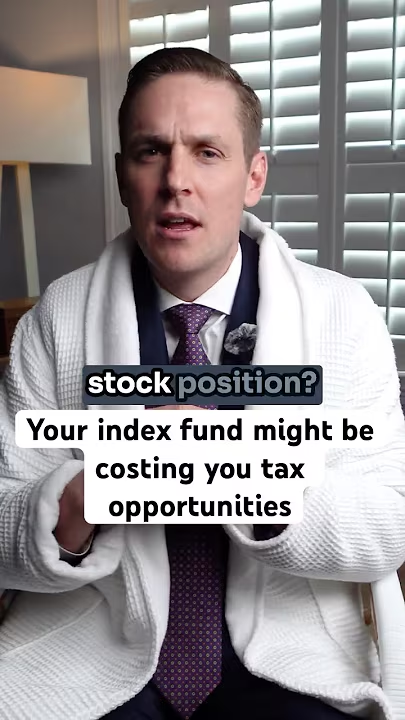
What is direct indexing? And does it make sense for business owners and high-income investors? Most people own the S&P 500 through a single index fund. Direct indexing means you own the individual stocks inside that index instead. That one difference opens up something most investors don't realize their portfolio can do: generate tax losses while staying fully invested in the market. When specific stocks inside the index dip, you can harvest those losses and immediately reinvest. The portfolio still tracks the market. But now it's also building up what's called Tax Alpha, the after-tax advantage created by systematically managing losses inside a taxable account. Over time, those losses accumulate. And when a major taxable event hits, like selling a business, a piece of real estate, or a large stock position, those losses can offset the capital gains from the sale. Same market exposure. Real tax savings. This tends to make the most sense for investors who have a large taxable account, high income, and a liquidity event somewhere on the horizon. If most of your money sits in a 401(k) or IRA, this strategy generally doesn't apply to those accounts. And the tax benefit varies by state. Some states don't conform to federal capital loss rules the same way, so run this by your advisor and your CPA before assuming the math works the same for you. The best tax planning for a big event starts years before the event. If you have a large taxable investment account or a potential liquidity event down the road, this is worth understanding now. Check out the full video for an example on how it works. #DirectIndexing #TaxAlpha #TaxPlanning #FinancialPlanning #WealthManagement #HighIncomeEarners #CFP #CapitalGains #TaxStrategy #BusinessExit #InvestSmart

.jpg)



Osaic Wealth Form CRS
Securities and investment advisory services are offered through Osaic Wealth, Inc., member FINRA/SIPC and a registered investment advisor. Additional investment advisory services offered through Strategic Financial Advisors Corporation, a registered investment advisor. Strategic Financial Advisors Corporation and Strategic Financial Services Corporation are not affiliated with Osaic Wealth, Inc.
This communication is strictly intended for individuals residing in states where the contracted representative is licensed. No offers may be made or accepted from any resident outside the specific state(s) the representative is registered. Current registered states: AZ, CA, CO, CT, DE, FL, GA, KY, MD, NJ, NM, NY, NC, PA, SC, TN, TX, VA. Please contact us to determine the states in which each representative is registered.
Broadridge Investor Communication Solutions, Inc. does not provide investment, tax, or legal advice. The information presented here is not specific to any individual’s personal circumstances.
To the extent that this material concerns tax matters, it is not intended or written to be used, and cannot be used, by a taxpayer for the purpose of avoiding penalties that may be imposed by law. Each taxpayer should seek independent advice from a tax professional based on his or her individual circumstances. Osaic Wealth, Inc. does not provide tax or legal advice.
These materials are provided for general information and educational purposes based upon publicly available information from sources believed to be reliable—we cannot assure the accuracy or completeness of these materials. The information in these materials may change at any time and without notice.
Certified Financial Planner Board of Standards, Inc. (CFP Board) owns the CFP® certification mark, the CERTIFIED FINANCIAL PLANNER™ certification mark, and the CFP® certification mark (with plaque design) logo in the United States, which it authorizes use of by individuals who successfully complete CFP Board’s initial and ongoing certification requirements.
PLEASE NOTE: The information being provided is strictly as a courtesy. When you link to any of the websites provided here, you are leaving this website. We make no representation as to the completeness or accuracy of information provided at these websites. The company is not liable for any direct or indirect technical or system issues or any consequences arising out of your access to, or use of third-party technologies, websites, information, and programs made available through this website. When you access one of these websites, you are leaving our website and assume total responsibility and risk for your use of the websites you are linking to.