




All
Thought leadership series
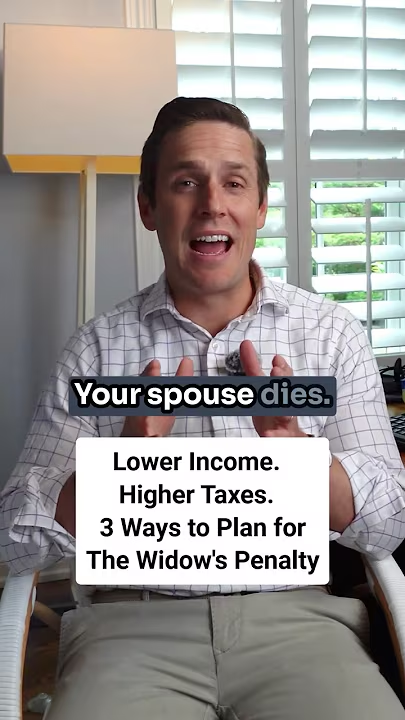
The Widow's Penalty - What happens to your taxes when your spouse dies.
What happens to my taxes after my spouse dies? For many surviving spouses, taxes can actually go up even though household income goes down. This is often referred to as the “widow’s penalty.” Here’s what that can look like. You and your spouse spend years building a retirement plan around two Social Security checks, your retirement accounts, and a tax strategy based on filing jointly. Then one of you passes away. One Social Security check goes a way. Many of the household expenses remain. And after the year of death, the surviving spouse is now likely filing taxes as Single. That can mean tighter tax brackets, a smaller standard deduction, and lower thresholds for determining how much of Social Security is taxable. Less household income. Potentially higher taxes. The best time to start planning for that isn’t after one spouse dies. It’s while both spouses are still here. Roth conversion analysis, income planning, Social Security decisions, and estate planning can help you understand what the surviving spouse’s financial life might look like and whether there are moves worth considering today. It’s not the easiest conversation to have with your spouse or your parents. But it’s a much better conversation to have before someone is forced to figure it out alone. #WidowsPenalty #TaxesAfterDeath #RetirementPlanning #TaxPlanning #FinancialPlanning #SocialSecurity

.jpg)


Osaic Wealth Form CRS
Securities and investment advisory services are offered through Osaic Wealth, Inc., member FINRA/SIPC and a registered investment advisor. Additional investment advisory services offered through Strategic Financial Advisors Corporation, a registered investment advisor. Strategic Financial Advisors Corporation and Strategic Financial Services Corporation are not affiliated with Osaic Wealth, Inc.
This communication is strictly intended for individuals residing in states where the contracted representative is licensed. No offers may be made or accepted from any resident outside the specific state(s) the representative is registered. Current registered states: AZ, CA, CO, CT, DE, FL, GA, KY, MD, NJ, NM, NY, NC, PA, SC, TN, TX, VA. Please contact us to determine the states in which each representative is registered.
Broadridge Investor Communication Solutions, Inc. does not provide investment, tax, or legal advice. The information presented here is not specific to any individual’s personal circumstances.
To the extent that this material concerns tax matters, it is not intended or written to be used, and cannot be used, by a taxpayer for the purpose of avoiding penalties that may be imposed by law. Each taxpayer should seek independent advice from a tax professional based on his or her individual circumstances. Osaic Wealth, Inc. does not provide tax or legal advice.
These materials are provided for general information and educational purposes based upon publicly available information from sources believed to be reliable—we cannot assure the accuracy or completeness of these materials. The information in these materials may change at any time and without notice.
Certified Financial Planner Board of Standards, Inc. (CFP Board) owns the CFP® certification mark, the CERTIFIED FINANCIAL PLANNER™ certification mark, and the CFP® certification mark (with plaque design) logo in the United States, which it authorizes use of by individuals who successfully complete CFP Board’s initial and ongoing certification requirements.
PLEASE NOTE: The information being provided is strictly as a courtesy. When you link to any of the websites provided here, you are leaving this website. We make no representation as to the completeness or accuracy of information provided at these websites. The company is not liable for any direct or indirect technical or system issues or any consequences arising out of your access to, or use of third-party technologies, websites, information, and programs made available through this website. When you access one of these websites, you are leaving our website and assume total responsibility and risk for your use of the websites you are linking to.